

Operating Mechanism of Automatic Folding Door-TAF100S
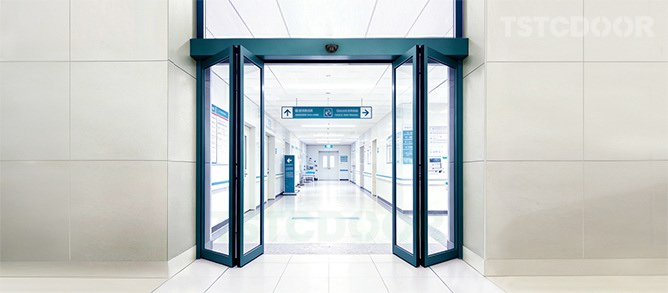
About the automatic folding door TAF100S, bi-parting (double-opening type), total 4 door leaves (2 leaves for each side), the core operating mechanism lies in motor drive + synchronous transmission + sensor signal feedback. It realizes the synchronous folding, opening and closing of door leaves through the linkage of mechanical structures, while cooperating with the control system to ensure safe and stable operation. The detailed operation process and core component principles are as follows .
I. Core Components
Drive System
▪ Main Drive Motor. DC brushless motor is usually adopted, installed in the top drive boxes of door frames on both sides to provide power for door leaf movement. They feature speed regulation and self-locking functions to prevent door leaf slippage when power is off .
▪ Transmission Gears/Timing Belts. Connect the motor output shaft with the door leaf linkage mechanism, converting the motor’s rotary motion into the linear + folding motion of door leaves.
Mechanical Linkage Mechanism
▪ Door Leaf Connecting Rod Set.The two door leaves on each side are connected via upper and lower hinges + synchronous connecting rods. The main door leaf(close to the door case) is directly linked to the drive system, while the secondary door leaf (outer side) is linked to the main door leaf through connecting rods to ensure consistent movement angle and speed of both leaves.
▪ Folding Limit Components. Guide rails and limit blocks are arranged at the top and bottom of door leaves to define the movement track of door leaves — when opening, the door leaves fold and retract to both sides along the guide rails,when closing, they unfold and align for sealing.
▪ Door Leaf Load-Bearing Wheels. Load-bearing pulleys are installed at the bottom of door leaves and embedded in the ground guide rails to reduce friction during door leaf movement and ensure stable operation.
Control System
▪ Main Control Unit. Receives sensor signals, controls the forward/reverse rotation, start/stop and rotation speed of the motor, serving as the "brain" of door operation.
▪ Trigger Sensors. Including microwave radar, infrared correlation sensors, induction pedals, etc., which send door-opening signals when detecting approaching people/objects, the door-closing delay device can set the automatic door-closing time when no one is present.
▪ Safety Protection Sensors. Such as anti-pinch infrared strips and pressure sensors, which immediately trigger motor reverse rotation when obstacles are encountered to prevent pinching or door damage.
Sealing and Buffering Components
▪ Sealing Rubber Strips. Elastic rubber strips are installed between door leaves and between door leaves and door frames to achieve sealing and sound insulation after door closing, while buffering the impact force of door closing.
II. Complete Operation Process
1. Door-Opening Action
The sensor detects approaching people/objects and sends a door-opening signal to the main control board, or the door-opening command is triggered via manual buttons or access control systems.
The main control unit controls the synchronous forward rotation of the main drive motors on both sides, driving the main door leaves on both sides to move outward along the top and ground guide rails.
The main door leaves pull the secondary door leaves through synchronous connecting rods, and the two door leaves fold inward synchronously, with the door leaves on both sides retracting toward the door frames on the left and right respectively.
When the door leaves fold to the preset maximum door-opening width, the limit switch is triggered, the motor stops running, and the door remains open.
2. Door-Closing Action
In the open state, if the sensor does not detect a new trigger signal within the set delay time, the main control board sends a door-closing command.
The main drive motors on both sides perform synchronous reverse rotation, the main door leaves drive the secondary door leaves to move reversely along the guide rails, and the folded door leaves gradually unfold and align.
When the door leaves are fully closed, the sealing rubber strips compress, the limit switch triggers the motor to stop. Some high-end models activate the motor self-locking function to prevent the door from being pushed by external forces.
3. Abnormal and Protection Action
During the door-closing process, if the safety sensor detects an obstacle, the main control board immediately instructs the motor to reverse, the door reopens, and then closes with a delay after the obstacle is removed.
When power is off, the motor self-locking function takes effect, keeping the door in its current state, some models are equipped with manual unlocking devices to allow manual pushing of door leaves for opening and closing.
III. Key Design Points
Synchronization Control .The movement of the four door leaves on both sides must be strictly synchronized, otherwise door leaf misalignment and jamming will occur. Therefore, the main control board needs to accurately adjust the rotation speed of the motors on both sides, and the connecting rod mechanism requires high dimensional accuracy.
Load Matching .The motor power must be matched according to the weight of the door leaves to ensure sufficient opening/closing power and stable operation.
Guide Rail Accuracy. The parallelism and flatness of the ground and top guide rails directly affect the operation noise and service life of the automatic folding door, which must be strictly calibrated during installation.
 General Safety Functions /Devi
 Advantages of Underground Driv
 Simplified Process of Powder C
 Automatic Curved Sliding Door