

Main Components & Operation Process of Sliding Door Operator
The automatic sliding door operator like TS300 is the core device that drives sliding doors to open and close automatically and ensures safe operation. The core components, their functions, and the linkage logic between components are described below.
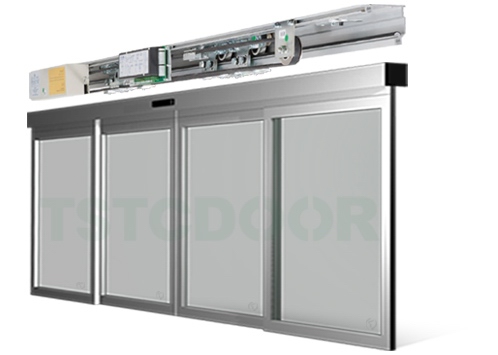
1. Core Components and Functions
▪ Drive Motor. It serves as the power source of the operator, usually adopting a DC brushless motor or AC asynchronous motor, featuring low noise, high torque, and stable operation. It receive commands from the control unit, output power to drive the transmission mechanism to operate, and realize the opening and closing of door leaves, adjust the rotation speed according to the load to adapt to door leaves of different weights.
▪ Transmission Mechanism. The common structure is synchronous belt drive or rack-and-pinion drive, connecting the drive motor and the door leaves. It convert the rotary power of the motor into the linear reciprocating motion of the door leaves, transmit power accurately, and ensure the smooth opening and closing of door leaves. Some high-end models are equipped with shock absorption components to reduce vibration and noise during operation.
▪ Control Unit (Main Control Board). It is equivalent to the "brain" of the operator, integrating a microprocessor, relays, and signal receiving modules. Receive signals from various sensors (such as human body induction and door position signals), send commands to the drive motor according to preset programs (such as opening and closing speed, door opening dwell time), it also has functions of fault self-detection and overload protection, and can record operating parameters.
▪ Sensor Assembly. It is the key to ensuring the safe and intelligent operation of automatic doors, mainly including two types as below .
Trigger Sensors /Detective Sensors. Such as microwave radar sensors and infrared sensors, which are used to detect human bodies or objects in front of the door and trigger the automatic opening of the door; they can also be matched with access control card readers and face recognition modules to realize access control linkage.
Safety Sensors. Such as anti-pinch infrared through-beam sensors and door anti-obstruction sensors. The former real-time monitors the door closing area to prevent pinching people or objects; the latter can sense the resistance during the operation of the door leaf, and immediately instruct the motor to reverse and open the door when encountering an obstruction.
▪ Limit Device. It is divided into mechanical limit and electronic limit.
Mechanical Limit. Limit the maximum opening/closing position of the door leaf through a limit block to prevent the door from over-traveling.
Electronic Limit. Detect the door position through a Hall sensor or photoelectric switch, feed back signals to the control unit, accurately control the start and stop positions of the door leaf, and adapt to different door opening sizes.
▪ Power Supply Assembly
It includes a power adapter and an optional backup power supply.
Power Adapter. Convert the mains power (AC220V) into the DC power required by the motor and control unit (such as DC24V).
Backup Power Supply. Automatically switch on in case of power failure to ensure that the door can be opened and closed manually or automatically, suitable for special scenarios such as fire exits.
2. Inter-component Linkage Logic (Core of Communication, Operation Process)
▪ Start-up Phase. The trigger sensor detects a human body/object → sends a door opening signal to the control unit → the control unit instructs the drive motor to start → the transmission mechanism transmits power to the door leaf → the door leaf opens.
▪ Operation Phase. The door leaf opens to the preset position → the limit device feeds back a signal → the control unit instructs the motor to pause (door opening dwell) → when the dwell time ends / the sensor does not detect any object → the control unit instructs the motor to reverse → the door leaf closes.
▪ Safety Protection Phase. During the door closing process, if the safety sensor detects an obstacle → immediately sends a signal to the control unit → the control unit instructs the motor to reverse and open the door → avoiding pinching or equipment damage; if the motor is overloaded (such as door jamming), the control unit triggers overload protection, stops the motor operation, and issues a fault alarm.
 General Safety Functions /Devi
 Advantages of Underground Driv
 Simplified Process of Powder C
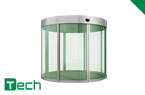 Automatic Curved Sliding Door