

Presence Detection /Presence Induction Radar for Automatic Doors
The presence detection radar also called presence induction radar, they are an automatic door sensing device based on the microwave Doppler effect. It is mainly used to continuously detect the presence of people or moving objects within the door's sensing area, serving as one of the core components for the safe operation and intelligent opening/closing of automatic doors. It is widely applied to various automatic door systems such as automatic sliding doors, revolving doors, and folding doors.
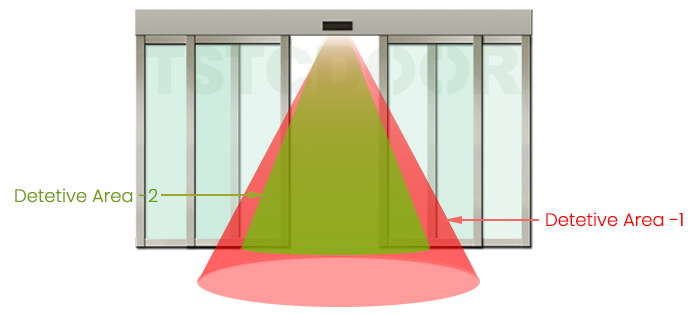
I. Core Working Principle
1. Doppler Effect Basics
The radar module continuously transmits microwave signals of a fixed frequency. When the signals encounter people or moving objects in the sensing area, the frequency of the reflected signals will shift (Doppler shift). After capturing the frequency change, the radar receiver converts it into an electrical signal and transmits it to the automatic door controller.
2. Presence Detection Logic
Unlike infrared sensors that only detect "motion triggering", presence detection radars can continuously monitor the presence status of targets, when a person enters the sensing area, the radar triggers a door-opening signal, when the person stays within the sensing area, the radar continuously outputs signals to keep the door open, after the person leaves the sensing area, the radar signal disappears and the door closes with a delay.
II. Main Functions and Advantages
1. Core Functions
Automatic Opening and Closing Control. Triggers the automatic opening of the door when detecting moving objects or people, controls the delayed closing of the door after people leave.
Anti-pinch Safety Protection. If the radar detects that there are still people or objects in the sensing area during the door-closing process, it will immediately send a signal to stop the door from closing and reopen it, avoiding pinching or collision.
Adjustable Sensing Area. The sensing range (width and depth) can be flexibly set by adjusting the radar's transmission power and sensitivity, adapting to different scenarios (e.g., narrow passages, hall entrances and exits).
2. Advantages Over Other Sensing Methods
Better Environmental Adaptability. The presence detection radar is unaffected by light and temperature, can penetrate non-metallic materials such as glass and plastic.
Better Detection Stability. They can detect both stationary and moving targets with continuous presence monitoring.
Better Installation Flexibility.The presence detection radar can be concealed and installed in the door body, ceiling or door frame.
III. Common Types and Installation Methods
1. Classification by Installation Position
Top-mounted Radar. Installed on the lintel or ceiling of the automatic door, the sensing area covers the area in front of the door in a fan shape downward. It is suitable for sliding doors and translational doors, being the most commonly used installation method.
Side-mounted Radar. Installed on both sides of the door frame, the sensing area is in a horizontal strip shape. It is suitable for revolving doors and folding doors, enabling accurate detection of people passing through both sides of the door body.
Embedded Radar. Embedded inside the door glass or door panel, featuring a concealed appearance that does not damage the aesthetic of the door body. It is suitable for high-end commercial automatic doors.
2. Classification by Sensing Range
Narrow-range Radar. With a sensing width of 1–2m and a depth of 0.5–1m, it is suitable for small passage doors and office doors.
Wide-range Radar. With a sensing width of 3–5m and a depth of 1–2m, it is suitable for automatic doors at high-traffic entrances and exits such as shopping malls and office buildings.
IV. Application Scenarios and Precautions
1. Typical Application Scenarios
Commercial Premises. Sliding doors and revolving doors in shopping malls, hotels and office buildings, ensuring the fast passage of people and avoiding pinching.
Industrial Premises. Automatic doors in factories and logistics channels, capable of detecting forklifts or personnel through dust and fog, adapting to harsh environments.
Medical Premises. Automatic doors in hospitals, where contactless sensing avoids cross-infection while stably detecting personnel pushing hospital beds.
2. Installation and Usage Precautions
During installation, avoid metal obstacles as metal will reflect microwave signals and cause false triggering.
Prevent the radar from directly facing strong electromagnetic interference sources (e.g., distribution boxes, motors) to avoid signal disorder.
Adjust the sensitivity according to the usage scenario to prevent frequent door opening and closing caused by detecting pedestrians outside the door due to excessively high sensitivity.
 General Safety Functions /Devi
 Advantages of Underground Driv
 Simplified Process of Powder C
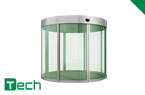 Automatic Curved Sliding Door