

Working Principles for Automatic Telescopic /Overlapping Sliding Door
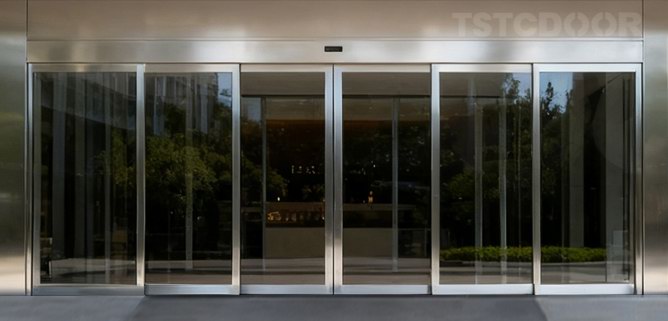
Automatic telescopic sliding door (also called overlapping sliding door) is the door system that integrate an electric drive and intelligent control module on the basis of manual telescopic door mechanical structures. Their core feature is that multiple door panels slide synchronously along tracks and overlap for storage when opened. They combine the advantages of space saving and automatic opening/closing, and are widely used in commercial, industrial, medical and other scenarios with high requirements for traffic efficiency and convenience.
I. Core Working Principles
The operation of automatic telescopic sliding door is jointly completed by three parts: mechanical transmission system + electric drive system + intelligent control system, with the specific logic as follows.
1. Basic Mechanical Transmission Structure
▪ Tracks and Pulley Blocks. The upper track serves as the load-bearing track, with high-strength pulley blocks built-in to bear the weight of all door panels. The lower track acts as the guide track to prevent the door panels from shaking or shifting during sliding. Tracks are usually made of aluminum alloy with a smooth surface treatment to reduce pulley friction resistance.
▪ Linkage Structure. Door panels are connected by synchronous belts, gear racks or linkage rods to ensure they maintain the same speed and distance during sliding, thus achieving the action of "overlapping sequentially and expanding sequentially". The number of door panels is commonly 4 pieces, with an overlapping ratio of up to 50%–70%, which maximizes the release of passage width.
2. Electric Drive System
▪ Power Source.The core component is a DC brushless motor (low noise, long service life) or an AC motor (high power, suitable for heavy-duty doors). After the motor reduces speed through a gearbox, it drives the driving wheel to rotate.
▪ Power Transmission.The driving wheel drives the synchronous belt/chain, which is fixedly connected to the pulley block of each door panel, thereby pulling all door panels to slide synchronously along the track. Some heavy-duty doors adopt dual-motor drive to improve power stability.
3. Intelligent Control System
▪ Trigger Module. It supports multiple door-opening signals, such as microwave induction sensors (inducing human movement), infrared sensors (anti-pinch protection + door-opening trigger), access control card swiping/password/facial recognition systems, remote controls and manual emergency switches.
▪ Control Logic. When the sensor or access control system receives a door-opening signal, it transmits the instruction to the control mainboard. The mainboard drives the motor to rotate forward, driving the door panels to overlap and open. After the door-opening delay ends, the motor reverses, and the door panels close. If an obstacle is detected during closing, the anti-pinch sensor will trigger the motor to reverse immediately, and the door panels will open again to avoid pinching.
▪ Backup Devices. It is equipped with an emergency power supply which can continue to work for at least 30 minutes in case of power failure.
II. Typical Application Scenarios
With the characteristics of automation, large traffic capacity and high space utilization rate, automatic telescopic sliding doors are suitable for the following scenarios.
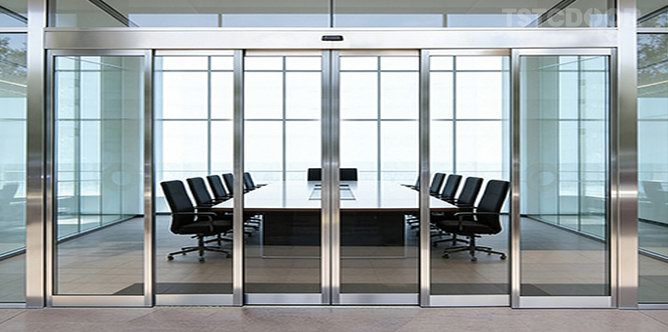
1. Commercial Retail Scenarios. Main/secondary entrances of shopping malls, supermarkets and shopping centers: The large-width design can meet the rapid traffic flow during peak hours. Induction door opening eliminates the need for manual pushing and pulling, improving the shopping experience. Glass door panels combined with intelligent dimming functions can also achieve a good display effect.
Brand stores and exhibition hall partitions. Electric control enables one-key switching between the "open display" and "closed partition" states, suitable for places that need flexible space adjustment.
2. Industrial and Warehousing Scenarios. Workshop and logistics warehouse passages: Heavy-duty automatic telescopic sliding doors can withstand frequent opening and closing. Combined with ground magnetic induction (inducing forklifts and trucks), they can realize automatic opening and closing, facilitating vehicle passage. Moreover, they do not occupy the internal operation space of the workshop when opened. Some doors used in cold storage and clean workshops are equipped with sealed thermal insulation layers to reduce energy loss.
3. Medical and Public Service Scenarios. Hospital operating rooms, clean wards and laboratories. Touchless induction door opening can reduce the risk of bacterial cross-infection. The good sealing performance of the door body can maintain indoor cleanliness and air pressure stability. Access control systems can restrict personnel entry and exit to ensure medical safety.
Passage doors of airports, high-speed railway stations and government service halls. Under the demand of large traffic flow, automatic opening and closing can improve traffic efficiency and reduce personnel congestion.
4. High-end Home and Office Scenarios. Villa balconies and living room partitions: Light-duty automatic telescopic sliding doors can be integrated with smart home systems (such as voice control and mobile APP control). When opened, they are hidden in the side walls, improving the aesthetic degree of the space. When closed, they have excellent sound insulation and heat insulation effects.
Office glass partitions. Electric control can quickly connect or separate office areas, suitable for the flexible layout of open office spaces.
III. About The Maintenance
▪ Clean debris on the track and pulley surface weekly, and lubricate mechanical components such as pulleys, gears and connecting rods monthly.
▪ Check the sensor sensitivity, synchronous belt tension and door panel fixing screws quarterly, and adjust and tighten them in time.
▪ Regularly check the power of the emergency power supply to ensure it can work normally in case of power failure.
▪ Avoid hitting the door panels with hard objects to prevent track deformation and sensor damage.
▪ Keep the intelligent control module away from moisture to prevent circuit short circuit.
 General Safety Functions /Devi
 Advantages of Underground Driv
 Simplified Process of Powder C
 Automatic Curved Sliding Door