

General Safety Functions /Devices of Revolving Doors |TSTC
The general safety functions and devices of revolving doors include the Non-contact Inductive Safety Devices, Contact Pressure Safety Edges, Braking, Emergency Stop & Power Safety Devices, Fire Emergency Safety Devices, Accessibility & Auxiliary Safety Functions and Warning Signs & Mechanical Auxiliary Safety, applicable to 2 wing, 3/4 wing automatic revolving door . Manual revolving doors may omit some sensors but shall retain brakes, speed limiters and anti-pinch seals.
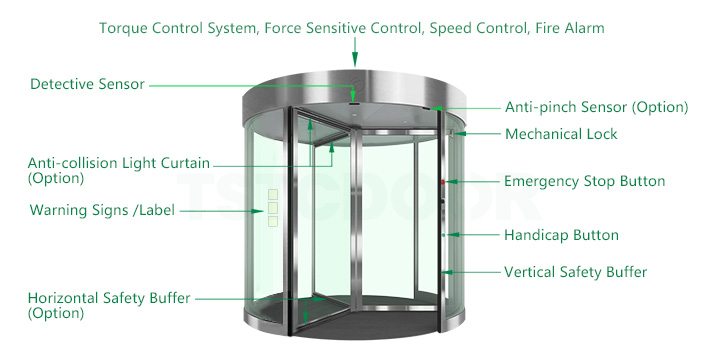
1. Non-contact Inductive Safety Devices (Predict hazards in advance to prevent pinching and collision, primary protection)
▪ Entrance presence sensor (Radar /Infrared /Laser). Detects pedestrians entering the door zone to trigger start-up, idles or stops when no person present to avoid injury from idle rotation.
▪ Deceleration infrared /light curtain sensor (middle height). Detects pedestrians approaching hazardous squeezing zones and reduces door speed for advance warning.
▪ Stop infrared /vertical safety light curtain (upper main anti-pinch protection). Beams installed downward from the canopy covering height 0~2000mm. Stops door movement immediately when persons or objects enter the gap between door wing and fixed column, protecting torso and arms.
▪ Low-level infrared / child anti-pinch sensor (mounted approx. 80~200mm above floor). Specifically protects feet, children and pets, eliminates blind zones at bottom to prevent foot pinching.
Upgrade option. Laser scanning safety sensor (replaces infrared light curtain with 3D scanning and fewer blind zones, widely used in high-end projects).
2. Contact Pressure Safety Edges (Last physical safeguard activated upon sensor failure)
▪ Vertical mullion pressure-sensitive safety edge (safety seal). Mounted on vertical frames of revolving wings and fixed curved wall columns, built-in pressure switch with full height ≥2000mm. The door stops immediately once pressure reaches the specified threshold, some models support slight reverse rotation to release pinched objects. The rubber also provides cushioning.
▪ Bottom safety edge. Fitted along the lower edge of door wings to prevent foot squeezing.
3. Braking, Emergency Stop & Power Safety Devices
▪ Red emergency stop pushbutton (E-Stop switch). Installed on both inner and outer columns at approx. 1.3m height. Pressing cuts off drive power and activates brake locking to stop the rotor completely. Reset required before restart.
▪ Electromagnetic safety brake (holding brake). Locks the revolving assembly upon power loss, emergency stop or fault to prevent coasting by inertia. Manual revolving doors are equipped with mechanical speed-limiting braking devices.
▪ Torque / current obstacle detection (motor force limitation). Monitors motor output torque. Automatically stops the door wing when hitting obstacles once torque exceeds limit, restricting maximum squeezing force (built-in software safety function).
▪ Overload protection. Motor overheat and overcurrent protection for shutdown upon faults.
4. Fire Emergency Safety Devices
▪ Fire alarm linkage interface. Upon fire signal from fire alarm system, revolving door stops and unlocks. The intermediate escape swing door of 2 wing revolving doors opens automatically to form an evacuation passage.
▪ Manual clutch release for power failure. Brake can be manually released during power outage, allowing manual rotation for evacuation. The intermediate swing door of 2 wing doors can be opened manually.
▪ Fault self-test function. Real-time self-check for safety sensors and brakes. Door cannot start or will stop with alarm if sensor wire breakage or failure occurs (mandatory requirement per national standard).
5. Accessibility & Auxiliary Safety Functions
▪ Disabled slow-speed button. Reduces door rotating speed and extends passage time after activation for wheelchairs and elderly people.
▪ Speed limiting function. Limits maximum linear rotating speed, lower speed limit for high-traffic sites.
▪ Reverse rebound function. Commonly used on 2 wing doors, door wing rebounds slightly upon impact to release squeezing pressure.
6. Warning Signs & Mechanical Auxiliary Safety
▪ Glass anti-collision warning strips. High-visibility stickers on glass panels to prevent collision with invisible glass door panels.
▪ Audible & visual alarm device. Buzzer + warning light activated on E-stop trigger, sensor fault or anti-pinch protection action.
▪ Mechanical buffer rubber stopper. Buffer at door wing end to reduce impact force.
▪ Safety gap control. Clearance control on fixed structures to prevent finger trapping.
7. Summary Table (for tender documents and technical specifications)
| Safety Category | Safety Function | Matching Devices |
| Pre-detection Protection | Presence detection, deceleration, pre-stop, full-height anti-pinch, low-level anti-pinch | Radar, infrared light curtain, laser scanning sensor |
| Contact Backup Protection | Stop / reverse rotation on pressure | Pressure-sensitive safety edge (safety seal) |
| Emergency Braking | E-stop shutdown, power-failure locking, obstacle force limiting | E-stop button, electromagnetic holding brake, torque monitoring |
| Fire Evacuation | Stop & unlock on fire alarm, escape door opening | Fire linkage module, manual clutch mechanism |
| Auxiliary Passage | Barrier-free low speed, fault self-test, audible & visual alarm | Disabled pushbutton, controller self-test, audible & visual alarm |
| Mechanical Protection | Buffering, visual warning | Buffer rubber, glass anti-collision marking |
 General Safety Functions /Devi
 Advantages of Underground Driv
 Simplified Process of Powder C
 Automatic Curved Sliding Door