

Automatic Curved Sliding Door VS. 3/4 Wing Revolving Door
Automatic curved doors and automatic revolving doors are much popular for modern buildings like hotels, shopping malls, office buildings etc.. Both curved sliding door & 3/4 wing revolving door are automatic type in this article, and the curved sliding door is the full-circle type here .
I. Core Differences in Basic Definition & Movement Mode
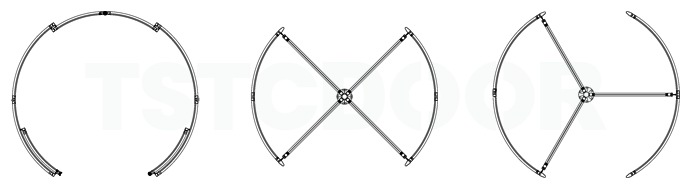
1. Full-Curved Automatic Sliding Door. Essentially a curved linear automatic door. Two curved glass door leaves slide reciprocally along a top circular curved track in an arc trajectory. When fully open, both leaves retract toward both sides along the curve and close afterward, it has no central vertical spindle.
2. 3/4 Wing Automatic Revolving Door . A central spindle rotary door. Three or four door wings are rigidly fixed to a vertical central main shaft and rotate circumferentially as a whole around the spindle continuously. Individual door leaves cannot slide separately, and the entire assembly moves in a circular path at all times.

II. In-Depth Comparison of Drive Systems (Key Section)
▪ Drive Structure of Full-Curved Sliding Door
1. Complete Drive Assembly
Integrated top drive beam, brushless DC servo motor, circular timing belt transmission system, sets of curved hanging rollers, multiple tension/idler pulleys, controller, top curved aluminum alloy track, buffer limit devices.
2. Transmission Principle
One motor drives a timing pulley, an S8M circular timing belt wraps around the full-circle track, with both belt ends fixed to the left and right door leaves respectively. Forward/reverse rotation of the motor pulls the belt, and hanging rollers drive the door leaves to slide synchronously left and right along the curved track.
Transmission form: Belt + hanging roller sliding transmission, rotary motion converted to curved linear sliding motion .
Force bearing point: All door weight is borne by top hanging rollers, vertical load is carried by the track .
Reduction mechanism: Built-in worm & worm gear reducer for low noise operation .
Guide accessories: Multiple inner track idler pulleys fitted for curved routing to prevent belt derailment .
3. Drive Characteristics
No central vertical column or bottom load-bearing spindle, all drive components are concentrated on the top header .
Two independent synchronously sliding leaves, supports single-side half-open mode, full-open mode and locking mode .
Low manual pushing resistance for easy manual operation during power failure .
▪ Drive Structure of 3/4-Wing Revolving Door
1. Complete Drive Assembly
Vertical central main spindle, top drive housing, high-power helical gear reduction motor, planetary gear reducer, electromagnetic brake, heavy-duty upper & lower thrust bearings, rigid connection flanges for door wings, dedicated PLC revolving door controller, full perimeter safety light curtains, bottom load-bearing bearing base.
2. Transmission Principle
Multi-stage helical gear reducer amplifies torque, output shaft directly connects to the central main spindle, which drives all 3/4 door wings to rotate circumferentially as a rigid unit. No belts adopted, purely rigid gear-spindle transmission.
Transmission form: Central spindle gear rotary transmission, rotary motion directly drives the full set of door wings for circular rotation .
Force bearing point: Upper and lower central spindle bearings carry total door wing weight plus wind load, axial gravity is borne by the bottom bearing .
Reduction mechanism: 2~3 stage hard-tooth helical gear reducer, output torque 400~600 N·m .
Balance structure: Cross tie rods installed between door wings to offset eccentric rotary load and avoid spindle deformation .
3. Drive Characteristics
Mandatory solid central column running from floor to top drive box .
All door wings rigidly interlocked to rotate as one unit, single-leaf independent opening is unavailable .
Electromagnetic brake locks spindle under power failure, requiring substantial force for manual pushing .
Dual upper/lower load-bearing bearings required, strict installation tolerance for floor levelness and spindle verticality (tolerance ≤2mm over 3m height) .
III. Mechanical Structure Comparison
Item | Curved Sliding Door | 3/4-Wing Automatic Revolving Door |
Main Frame Skeleton | Circular curved top track + surrounding fixed curved glass wall, no central column | Vertical central main spindle + outer curved enclosure, central column is non-negotiable |
Door Leaf Structure | 2 independent curved glass leaves without rigid interconnection, separable sliding motion | 3/4 flat fan-shaped door wings rigidly locked to central spindle, synchronized rotation only |
Bottom Support | No bottom load-bearing structure, only anti-collision rubber strips on floor surface | Heavy-duty thrust bearing base at bottom, floor reserved pit for spindle installation |
Guiding & Running Parts | Top curved hanging rollers (load bearing + guiding function) | Only upper/lower central spindle bearings, no running rollers on door wings |
Limiting Mechanism | Mechanical buffer stoppers at both track ends, auto stop upon full open position | No fixed travel limit, continuous low-speed circulating rotation with speed adjustment upon pedestrian detection |
Sealing System | Rubber gaskets fit curved fixed wall when leaves are closed, two open access ends remain | Two door wings separate indoor & outdoor air at any rotation angle for full perimeter isolation |
Emergency Evacuation | Full circular passage unobstructed after full opening, compliant with fire evacuation codes | Narrow rotary aisle, mandatory auxiliary side sliding escape door per building codes |
IV. Differences in Control System & Sensor Logic
1. Control Logic of Full-Curved Sliding Door
Sensors: Microwave radar at entrance, motor activates upon human approach, door leaves slide open along the curve to both sides, auto-close after delay when pedestrian leaves .
Operation Modes: Auto full open, half-open (single side only), permanent hold open, locked .
Safety Protection: Belt rebound anti-pinch triggered by obstacle detection during closing, anti-collision protection only on leaf edge .
Control Logic: Recurrent start-stop cycle, door rests stationary after completing one open-close cycle until next trigger signal .
2. Control Logic of 3/4 Wing Revolving Door
Sensors: Entrance radar + inner door wing safety light curtains, automatic speed increase when pedestrian enters, low-speed standby when vacant .
Operation Modes: Continuous circulating rotation, stop & lock, fire forced stop .
Safety Protection: Full perimeter anti-pinch light curtains, bottom door wing anti-collision strips, spindle overload torque protection, reverse rotation anti-collision function .
Control Logic: Uninterrupted circular circulation, never fully stationary, always maintaining separated passage compartments .
V. Comparison of Passage Capacity, Space Occupancy, Energy Consumption , Maintenance
1. Pedestrian Throughput
Full-curved sliding door: Wide unobstructed passage after full opening, simultaneous access for pedestrians, wheelchairs and trolleys, capacity 60–80 persons per minute .
3/4-wing revolving door: Only 1–2 occupants per compartment, trolley passage restricted, capacity 30–50 persons per minute, prone to congestion during peak hours .
2. Space Requirement
Full-curved sliding door: Minimum inner diameter 2.4–3.6m, no central column occupying internal passage space .
Revolving door: Minimum inner diameter ≥3.0m, central column blocks passage, narrower effective clear width at identical diameter .
3. Air Tightness & Energy Saving
Revolving door performs best: Constant partition between indoor & outdoor air flow, reducing air conditioning energy consumption by ~30%, ideal for extreme hot/cold climates .
Full-curved sliding door: Good sealing when closed, yet direct air convection occurs when fully open, energy saving efficiency improved by only 15%~20% .
Annual Maintenance
Curved sliding door: Work scope includes curved track cleaning, timing belt replacement, hanging roller lubrication.
Revolving door: Regular spindle bearing grease refilling, door wing balance calibration, gear wear inspection required.
Failure Rate: Curved sliding door features simple structure with easily replaceable belts, revolving doors face complex repairs and expensive spare parts once gears or spindle bearings wear out .
 General Safety Functions /Devi
 Advantages of Underground Driv
 Simplified Process of Powder C
 Automatic Curved Sliding Door