

Simplified Process of Powder Coating /Painting For Aluminum Profiles
About the automatic door products from TSTC, like revolving door, sliding door, swing door, balanced door, all the structures and surfaces are made from aluminum profiles which need to undergo surface treatment, and the most commonly used surface treatment is powder coating /painting .
Simplified Complete Process
Pretreatment is critical to preventing later‑stage peeling. Most early‑stage coating failure within one‑year service originates from defective pretreatment.
1. Loading . Hang profiles onto coating racks to ensure good electrical conductivity. Select concealed positions for rack contact points whenever possible.
2. Pretreatment (spray‑on or immersion process). ① Degreasing & oil removal → ② Water rinsing → ③ Alkali etching (remove native oxide skin) → ④ Water rinsing → ⑤ Neutralization & brightening → ⑥ Water rinsing → ⑦ Chromate / chrome‑free conversion coating formation → ⑧ Pure water rinsing → ⑨ Drying .
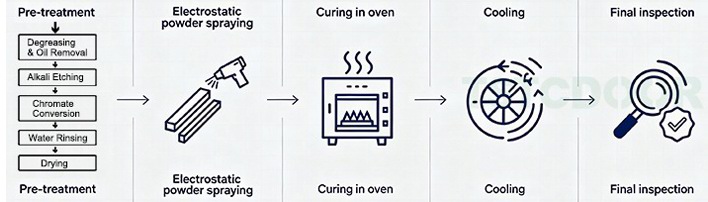
3. Electrostatic powder spraying. Powder particles adhere to profile surfaces via electrostatic guns, control coating film thickness.
4. High‑temperature curing. For polyester powder: typical workpiece temperature 180~200 °C, hold for 10~15 minutes subject to powder supplier specification. Use actual workpiece temperature rather than oven display reading.
5. Cooling. Allow natural cooling down to ambient temperature.
6. Unloading, inspection & packaging. Conversion coating: acts as bonding bridge between aluminum substrate and powder layer. Poor conversion coating will lead to peeling in service.
Critical Process Parameters (Special for revolving‑door aluminum profiles)
1. Powder selection
▪ Outdoor application (revolving doors, building facades): outdoor weather‑resistant polyester powder is mandatory. Indoor epoxy powder shall not be used outdoors. Indoor powder will fade and chalk within months to one year under outdoor exposure.
▪ Film thickness: national standard range 60~120 μm, recommended working range 70~100 μm. Too‑thin film reduces weather resistance, excessive thickness causes sagging and pinholes.
2. Pretreatment highlights
▪ Thoroughly remove drawing oil, release agent, fingerprints and hand grease.
▪ Avoid over‑alkali‑etching which causes pitting and porous substrate surface.
▪ Continuous and uniform conversion coating, free of residual ash or whitening. Final rinse shall use pure water to eliminate tank‑solution residue.
▪ After drying, profiles shall be clean, water‑stain‑free, oil‑free and fingerprint‑free.
3. Spraying & curing
▪ Adjust electrostatic parameters to minimize Faraday‑cage effect, ensure full powder deposition on corners and inner cavities.
▪ Follow powder supplier's curing temperature‑time strictly.
Insufficient curing → poor adhesion & peeling risk.
Over‑curing / over‑heating → powder over‑burning, early fading and colour loss.
Note: Judge by actual workpiece temperature. Wall‑thickness variation changes heating‑up performance.
4. Post‑processing & assembly precautions (common hidden risks)
Preferred workflow: cut & drill first, then perform powder coating (optimal solution).
▪ If cutting / drilling is carried out after coating: bare aluminium on cut‑edges and drilled holes must be sealed / touch‑up‑sprayed. Otherwise rain‑water and moisture penetrate underneath coating and trigger blistering & peeling (very frequent failure on revolving doors).
▪ Use soft protective padding during handling and stacking to avoid scratch‑impact damage. Wear gloves, bare‑hand contact with coated surfaces is forbidden.
▪ Apply PE protective film for packaging. Avoid high‑temperature storage which may cause film sticking onto coating.
Common Defect Root‑cause Reference Table
Phenomenon | Main Process Causes |
Coating peeling & delamination | Inadequate degreasing, defective conversion coating, insufficient curing, moisture intrusion from unsealed cut edges |
Early colour fading, gloss loss & chalking | Wrong indoor‑grade powder, poor‑quality weather‑resistant powder, over‑curing |
Pinholes & bubbles | Residual water / oil on substrate, oil‑water contamination in compressed air |
Local poor powder deposition | Poor rack conductivity, Faraday‑cage shadow zones |
 General Safety Functions /Devi
 Advantages of Underground Driv
 Simplified Process of Powder C
 Automatic Curved Sliding Door