

About The Energy Saving of Automatic Revolving Doors
As a high-quality entrance solution widely adopted in hotels, commercial complexes, office buildings and airports, the automatic revolving door is admired not only for its elegant appearance and stable operation, but also for its outstanding energy-saving performance, which helps buildings cut HVAC operating costs and reduce carbon emissions.
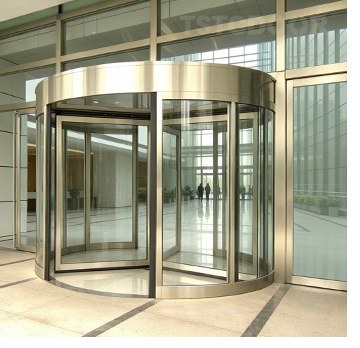
The core secret behind its energy-saving effect lies in the unique "always open, always closed" design. Unlike swing doors or sliding doors that create a direct, unobstructed passage between indoors and outdoors when opened, the revolving door forms an airlock chamber by its rotating glass wings. While pedestrians pass through one compartment, other door panels stay sealed against the curved enclosure. This structure avoids direct convection of hot and cold air and greatly limits air infiltration and escape of conditioned indoor air. Relevant research shows that ordinary swing doors allow approximately eight times more air exchange than revolving doors. In summer, it prevents cool air from leaking out and blocks hot outdoor air from flooding in winter, it keeps heated air inside and stops cold drafts entering the lobby. As a result, the air-conditioning and heating load is significantly reduced, bringing steady energy savings all year round.
Modern automatic revolving doors further amplify energy efficiency through intelligent drive systems. Equipped with variable-frequency smart motors, the door can automatically adjust rotating speed according to real-time pedestrian flow. When visitor volume is low, it runs at a slower speed to lower power consumption, during peak hours, it speeds up moderately to ensure smooth passage without unnecessary energy waste. Compared with constant-speed drive systems, this humanized control logic minimizes idle power loss of the door itself. Good sealing workmanship also plays an important role. Reliable sealing strips along door wings reduce air leakage gaps, stabilizing the air-lock effect and maximizing energy-saving gains.
It is worth noting that energy-saving performance is closely related to proper model selection, installation and daily maintenance. For extra-wide or extra-high entrances, a two-wing automatic revolving door with reinforced structure is recommended to maintain good sealing performance. The working environment should also be kept within the specified range: ambient temperature between -10°C and 40°C, and relative humidity below 75%. Excessive wind pressure will break the air isolation effect, so it is suggested that the on-site wind speed should not exceed 15 m/s. Regular maintenance is essential as well. Dust accumulated on infrared sensors will cause abnormal operation, and worn sealing strips will lead to air leakage. Wiping sensors with dry cloth and replacing ageing accessories on schedule can keep its energy-saving capability stable in long-term use.
Against the background of green building and low-carbon development, the automatic revolving door has become a practical sustainable entrance product. It balances aesthetic presentation, safe pedestrian passage and energy conservation. For property owners and architects, choosing a well-designed automatic revolving door is not merely an upgrade of building decoration, but also an effective way to lower long-term operational expenses and realize greener building management.
Note: As one of China’s leading automatic door suppliers, TSTC has specialized in the automatic door industry for more than 10 years. Our core management, technical and sales personnel each boast over 15 years of experience in this field. Our main products include ordinary 3/4 wing revolving door TAR300, 2 wing luxury revolving door TAR200, all-glass revolving door TAR600, the best popular hospital hermetic door TH100, and the best selling swing door operator TSW100. Our automatic doors above have already been exported to over 20 countries across Southeast Asia, Europe,the Americas, trusted by numerous prestigious Hotels, Hospitals, Office Buildings, Chain Supermarkets and Commercial Complexes.
 About The Energy Saving of Aut
 Common Types of Medical Airtig
 Feasible Future Technological
 How to Clean and Disinfect Aut