

Common Types of Medical Airtight Doors -TSTC
Medical airtight doors also called hermetic doors are widely used across healthcare facilities and cover ward doors, examination room doors, automatic sliding doors, clinic doors, emergency exit doors, restroom doors and more. These medical doors are built for distinct functional requirements, and their design concepts vary accordingly. What are the mainstream types of medical airtight doors available on the market? Detailed information is provided below.
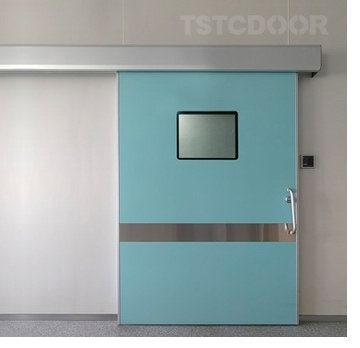
1. Classification by Opening Configurations
Based on different opening forms, medical airtight doors mainly include single-leaf doors, double-leaf doors and Dutch doors (mother-and-child doors). A standard single manual door usually provides a clear passage width of 0.9~1.1 m, while a single-open automatic airtight door offers an opening width ranging from 1.2 m to 1.5 m. A mother-and-child door consists of a smaller normally-fixed leaf and a larger operable leaf. For entryways wider than 1.5 m, double-leaf airtight doors with two equal door panels are normally adopted. This type is well suited for medium and large multi-function halls. Three-leaf and four-leaf configurations are rarely used in medical settings, so they will not be elaborated here.
2. Classification by Design: With or Without Transom Windows
If you observe ICU ward doors carefully, you will notice some are fitted with an integrated fixed glazed transom window above the door leaf, which is often referred to as a glazed overhead panel, while others have no such structure. The main consideration lies in the stability of the door leaf. The typical height range for a door leaf is 2.0 m to 2.1 m. An excessively tall door leaf will compromise structural stability and reliable operation. When the doorway height exceeds this standard range, the leftover space above the door leaf can be designed as a transom glazed window. This design improves natural light penetration and makes full use of the vertical space of the doorway.
3. Classification by Design: With or Without Observation Windows
The decision to add an observation window depends on the functional needs of the medical area. Ward doors and examination room doors, for example, are usually equipped with observation windows. They allow medical staff to view the indoor conditions conveniently without opening the door and help boost indoor brightness and light transmission. Nevertheless, certain specialized departments have strict requirements that prohibit observation windows for infection control, privacy or radiation protection purposes.
Should you have any inquiries, feel free to contact our team or browse our official website for further information.
 About The Energy Saving of Aut
 Common Types of Medical Airtig
 Feasible Future Technological
 How to Clean and Disinfect Aut