

Brief Introduction For Automatic Revolving Doors - TSTC
An automatic revolving door is a commercial entrance system driven by motor and control unit to rotate door panels around a central vertical shaft. Equipped with induction sensors to start and stop automatically, it maintains a continuous partial closure while allowing passage. It is a preferred entrance solution for high-end buildings, as it keeps indoor and outdoor air separated at all times.
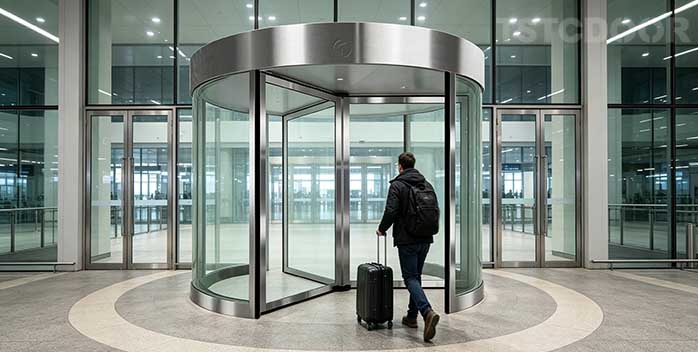
▪ Working Principle
Radar or infrared sensors detect approaching pedestrians. The control unit activates the motor to drive the central shaft and door panels at a low speed. Pedestrians enter the compartment formed by two door wings and rotate to the exit side. The door runs at low standby speed or stops when no one is passing. It is fitted with torque detection and infrared anti-pinch protection and stops immediately upon encountering obstacles. It can be pushed manually in case of power failure.
▪ Main Types
1. 2 wing Automatic Revolving Door
Premium model with a built-in straight emergency exit door. Widely used in star hotels and large complexes. It provides ample space for stretchers and luggage carts, with a larger diameter and higher cost.
2. Ordinary 3/4 wing Automatic Revolving Door
Most common type with three or four door wings. Balanced performance and cost. Popular for office buildings, hotels and banks.
Also with three or four door wings , but the door body is almost all glass with only less much slimmer alumium profiles, what's more, he driving motor, control unit and other key parts are all adopt underground type, so the whole revolving door is much more transparent. The all-glass revolving door maybe the most suitable door to the modern buildings, especially for the ones with stunning glass facade.
▪ Basic Structure
1. Fixed frame: circular outer columns and ceiling, made of aluminium profile or stainless steel.
2. Rotating assembly: central shaft and door wings with tempered safety glass.
3. Drive system: motor and reducer.
4. Control system: main controller, radar sensors, safety sensors.
5. Safety components: infrared anti-pinch sensors, fire linkage module.
▪ Advantages
1. Excellent air tightness, reduces loss of heating and cooling energy, windproof, dustproof and sound-insulating, weakens stack effect in high-rise buildings
2. Elegant appearance, enhances lobby image
3. Separates incoming and outgoing pedestrian flow
4. No extra swinging space required compared with swing doors
▪ Disadvantages
1. Higher cost for fabrication, installation and maintenance than automatic sliding doors
2. Limited compartment space, difficult for large trolleys and bulky goods (2 wing version is better)
3. Requires circular opening in civil construction
▪ Application Scenarios
Star hotels, Grade A office buildings, bank headquarters, exhibition centers, airports, high-end shopping malls, government buildings, clean workshops, hospital lobbies and other main entrances.
 Brief Introduction For Automat
 Certificate of Origin (CO) For
 The Research For Global Hermet
 Are Revolving Doors Worth Inst