

Technical Feature and Maintenance for All-glass /Full-glass Revolving Doors
The full-glass /all-glass /crystal 3/4-wing revolving door is a high-end entrance and exit device that combines full-glass transparent design with a 3/4-wing high-efficiency passage structure. It integrates aesthetics, practicality and safety, and is widely used in high-end commercial and public building scenarios.
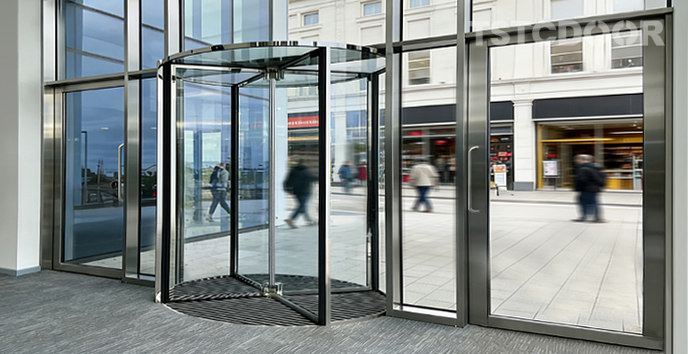
I. Core Technical Features
▪ Structural Design Advantages
3/4-wing layout: The 3/4-wing type has a larger gap between door leaves and higher passage efficiency. Meanwhile, it retains the windproof, dustproof and sound insulation performance of revolving doors, effectively maintaining a constant temperature environment inside the building and reducing air conditioning energy consumption.
Full-glass frameless/narrow-frame design: Door leaves and frames are mostly made of tempered glass or laminated glass, combined with aluminum alloy narrow frames or frameless structures. It features strong visual transparency, can perfectly adapt to the minimalist style of modern buildings, and enhances the aesthetics of entrances and exits.
Bidirectional passage + emergency mode: It supports bidirectional automatic induction passage. In case of emergency, it can be switched to manual mode to meet fire evacuation requirements.
▪ Drive and Control Technology
SIEMENS motor drive: It operates smoothly with low noise and low energy consumption, and is equipped with overload protection function, suitable for scenarios with frequent start-stop operations.
Intelligent induction system: Equipped with radar or infrared sensors, it can accurately identify the direction of pedestrians entering and exiting, automatically adjust the rotation speed of door leaves, and avoid the risk of pinching. Some high-end models support access control integration functions such as face recognition and card swiping.
Speed-adjustable function: The rotation speed of door leaves can be adjusted manually or automatically according to passenger flow, improving passage efficiency during peak hours and reducing energy consumption during off-peak hours.
▪ Safety Protection Configuration
Glass safety guarantee: Tempered laminated glass is adopted, which will not splash and hurt people when broken, complying with the building safety glass standards. Anti-collision sealing strips are installed on the edge of door frames to reduce collision damage.
Anti-pinch induction device: Safety switch, torque control system, force sensitive control system, when encountering obstacles, the door leaves will automatically stop or reverse to protect the safety of pedestrians and objects.
II. Suitable Application Scenarios
With the balance of aesthetics and functionality, full-glass 3/4-wing revolving doors are mainly used in places with high requirements for quality and image:
High-end commercial buildings: Main entrances and exits of five-star hotels, high-end shopping malls and brand flagship stores. The transparent design can display the interior decoration of the building and enhance the brand image.
Grade A office buildings: Meeting the high-frequency passage needs of business people, while isolating outdoor noise and dust to maintain the comfort of the office environment.
Public venues: Cultural venues such as exhibition centers, theaters and art galleries, which balance aesthetics and passenger flow evacuation efficiency, and adapt to the artistic atmosphere of the venues.
Medical institutions: Entrances and exits of high-end private hospitals and physical examination centers. The stable operation and low-noise design can avoid disturbing patients, and it also has the advantages of hygiene and dust prevention.
III. Daily Maintenance and Upkeep
The maintenance of full-glass /all-glass /crystal 3/4-wing revolving doors needs to take into account mechanical components, electrical systems and glass cleaning to extend service life and ensure operational safety.
1. Daily Cleaning (Daily/Weekly)
Glass cleaning: Wipe with neutral glass cleaner and soft cloth. Avoid using strong acid and alkali cleaners to prevent corrosion of glass coatings. Regularly wipe dust off the door frame sealing strips to maintain sealing performance.
Appearance cleaning: Wipe the aluminum alloy frame with a damp cloth, and avoid scratching the surface coating with sharp objects. The induction area (radar/infrared probe) should be kept clean to prevent dust from blocking and affecting induction sensitivity.
2. Regular Inspection (Monthly/Quarterly)
Mechanical components: Check the wear condition of door leaf rotating shafts and guide wheels, and add lubricating oil to keep them running smoothly,tighten loose screws to prevent door leaves from swaying.
Electrical system: Check whether the power cords and sensor connecting wires are damaged, and whether there is dust accumulation in the control box. Clean it in time and take moisture-proof measures, test whether the emergency unlocking function is normal.
Safety devices: Test the anti-pinch sensors and overload protection functions to ensure that the door leaves can stop or reverse in time when triggered by obstacles.
3. Annual In-depth Maintenance (Annually)
Professional technicians disassemble core components such as drive motors and reducers for comprehensive inspection and replacement of worn parts.
Calibrate the sensitivity of the induction system and update the access control system firmware (if any).
Check the connection structure between glass and frame to ensure there is no looseness or cracking. Replace aging sealing strips if necessary.
4. Maintenance Notes
Avoid hitting door leaves with heavy objects and hanging items on door leaves.
Timely clean up water and debris in the bottom guide rail after rainy or snowy days to prevent rust or jamming.
Non-professionals are not allowed to disassemble the control box or drive components without permission. Contact the manufacturer's after-sales service in case of failure.
 Certificate of Origin (CO) For
 The Research For Global Hermet
 Are Revolving Doors Worth Inst
 Liabilities For Seller & B