

Structure for Large 3/4 Wing Revolving Door -Diameter Over 5 Meters
To TSTC 3/4 wing revolving door with the model TAR300, the normal structure is that all the door wings are fixed on the central axis, when the motor drives the central axis to rotate, the door wings will also rotate accordingly. With this structure, the diameter of the revolving door could be from 1600mm to 3600mm, within these dimension, the door could be revolve normally.... When the diameter is bigger like 4 meters, 5 meters or more, the outer ends of the door wings are easy to sag, how to deal with this problem ? Please check the part as below .
The core design philosophy to prevent sagging at the outer ends of door wings is strengthening the rigidity of door wings, adopting a dual-support structure of top suspension and bottom bearing, adding intermediate supports, optimizing bearing and suspension systems, and selecting high-strength materials.
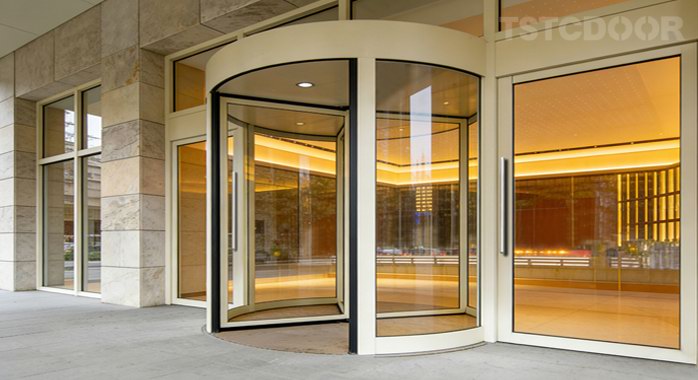
1. Door Wing Structural Reinforcement (Core Anti-Sagging Measure)
▪ Heavy-Duty Truss / Box Frame Structure
Adopt box beam + truss structure for door wings (instead of ordinary profiles), with internal stiffeners / triangular supports to form a stable stress network.
Use high-strength aluminum alloy (6063-T6) or carbon steel for main beams with enlarged sections (e.g., 150×100mm) to improve bending stiffness.
Use laminated tempered glass for glass panels, reinforced with aluminum alloy edging and stainless steel corner brackets to avoid glass deformation.
▪ Outer End Reinforcement and Pre-Camber Design
Install thickened end plates + triangular reinforcing ribs at the outer ends of door wings to counteract cantilever bending moments.
Apply pre-camber (pre-deformation) during fabrication: slightly raise the outer ends of door wings upward by 2–5mm in advance to offset self-weight sagging.
2. Dual-Pivot Support System (Top & Bottom Shaft + Rail)
▪ Top Suspension Support (Critical)
Central shaft + top load-bearing beam: Use I-beam / box beam for the top annular load-bearing frame. The upper end of each door wing is suspended via heavy-duty bearing housings with multiple sets of thrust ball bearings.
Multi-point suspension: Install 2–3 suspension points on the top of each door wing (not single-point), connected to the top main beam through high-strength stainless steel tie rods / steel wire ropes to form a cable suspension system.
Adjustable suspension: Equip suspension points with adjusting screws for precise leveling after installation, compensating for manufacturing and installation errors.
▪ Bottom Bearing Support (Bottom Anti-Sagging)
Bottom annular rail + guide pulleys: Install heavy-duty wear-resistant pulleys at the outer bottom of door wings, running along a stainless steel annular rail to bear vertical loads.
Bottom rotating shaft + bearings: Install heavy-duty thrust bearings at the bottom center with a circular truncated bearing housing to distribute door weight.
Anti-tilt wheels: Install lateral guide wheels on the inner bottom of door wings to prevent horizontal shaking during rotation.
3. Intermediate Auxiliary Supports (Essential for Large Diameters)
Intermediate cantilever supports: Add auxiliary support wheels / idlers at the middle of door wings (1/2–2/3 of the radius) to share the bending moment at the outer ends.
Inter-wing connections: Install transverse tie rods / struts between adjacent door wings to form an integral rigid frame and avoid independent sagging of single wings.
4. Material and Mechanical Optimization
High-strength materials: Main beams: 6063-T6 aluminum alloy (yield strength ≥ 240MPa) or Q355B carbon steel. Connectors: 304 / 316 stainless steel to prevent loosening caused by corrosion.
Finite element analysis: Conduct mechanical simulation before design to optimize beam sections and support positions, ensuring maximum deflection ≤ L/1000 (L = length of door wing).
5. Bearing and Drive System
Top bearings: Use a combination of double-row tapered roller bearings + thrust ball bearings to withstand both radial and axial loads simultaneously.
Bottom bearings: Heavy-duty deep groove ball bearings + thrust bearings to reduce friction and wear.
Drive system: Dual-motor synchronous drive to ensure synchronized movement of multiple wings and even stress distribution.
6. Installation and Commissioning Requirements
Levelness and verticality: Strictly level during installation. Horizontal error of the top annular beam ≤ 1mm/m, verticality error of the central shaft ≤ 2mm/3m.
Preloading and adjustment: Pre-tighten suspension tie rods, maintain adjustable clearance between bottom pulleys and rails, conduct regular inspections and fine-tuning during operation.
Maintenance: Regularly lubricate bearings, inspect connectors, and tighten bolts to prevent loosening and sagging.
7. Typical Structural Scheme (5–6 Meter Diameter)
Door wings: Box-type aluminum alloy frame + stiffeners + laminated glass .
Top support: Top annular I-beam + 3-point suspension + adjustable tie rods .
Bottom support: Bottom annular rail + heavy-duty pulleys + central bearings .
Intermediate support: Auxiliary idlers at the middle of door wings + transverse tie rods between wings .
With the above combination, the sagging at the outer ends of door wings can be controlled within 1~2mm for long-term stable operation.
 General Safety Functions /Devi
 Advantages of Underground Driv
 Simplified Process of Powder C
 Automatic Curved Sliding Door