

Encoder for Automatic Revolving Doors
We often see the automatic revolving doors in hotel/resort, office building, shopping mall, airport and other type of projects, and we find the door wings always stop/start at a fixed correct position, also locked at a fixed position..... It's because of a key electronic part called encoder.
Encoder is the critical component in automatic revolving doors for achieving precise positioning of the door wings. They function as the "eyes" of the control system, providing real-time feedback on the door's rotational movement, which make the revolving door smart. The details are as below .
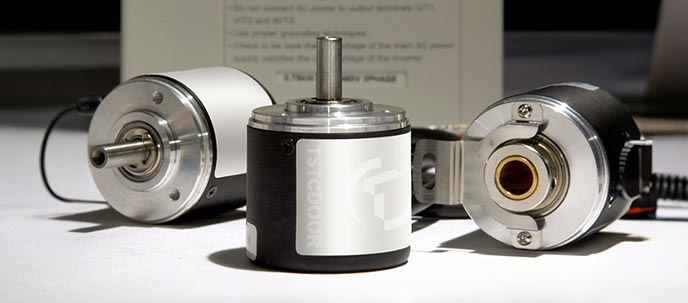
1. Types of Encoders Used in Revolving Doors
A. Rotary Encoders
A-1. Incremental Encoders
Generate pulse signals (A, B, and sometimes Z channels) as the motor shaft rotates.
The control system counts pulses to determine position and speed.
Requires a reference point (homing) at startup since it only tracks relative movement.
Example: If the encoder emits 1000 pulses per revolution (PPR), each pulse equals 0.36° of rotation.
A-2. Absolute Encoders
Provide a unique digital code for each shaft position (even after power loss).
Use binary, Gray code, or serial protocols (e.g., SSI, BiSS).
No need for homing, ideal for safety-critical applications.
Example: A 12-bit encoder offers 4,096 unique positions per turn (~0.088° resolution).
B. Linear Encoders (Less Common)
Used in some high-end systems where the door’s rail movement must be tracked directly.
Work similarly to rotary encoders but measure linear displacement (e.g., optical or magnetic scales).
2. How Encoders Enable Precision
A. Closed-Loop Control. The encoder feeds real-time position data to the PLC/microcontroller, which compares it to the target position and adjusts the motor output (via PID control).
B. Speed Regulation. By monitoring pulse frequency, the system ensures smooth acceleration/deceleration to avoid jerky movements.
C. Synchronization. In multi-wing doors, encoders ensure all leaves maintain equal spacing (e.g., 120° apart in a 3-wing door).
3. Practical Challenges & Solutions
A. Backlash Compensation. Mechanical play in gears can cause errors. Encoders help detect and correct this via software.
B. Environmental Factors. Dust/moisture can affect optical encoders; sealed or magnetic encoders (e.g., Hall-effect) are preferred.
C. Redundancy. High-end doors may use dual encoders (motor + door shaft) to detect belt slippage or mechanical failure.
4. Example Workflow
Command. The control system signals the motor to rotate the door 90°.
Feedback. The encoder sends 250 pulses (for a 1,000 PPR encoder = 90°).
Adjustment. If only 240 pulses are detected, the PID controller increases motor torque to reach the target.
Stop. Once the exact position is confirmed, the motor brakes dynamically (no overshoot).
 General Safety Functions /Devi
 Advantages of Underground Driv
 Simplified Process of Powder C
 Automatic Curved Sliding Door