

Automatic Revolving Doors In Next 10 years | TSTC
Over the next decade, automatic revolving doors will evolve from mechanical drive plus basic automation to full adoption of direct drive, AI intelligent control, multi-sensor fusion, energy conservation and digital twin operation & maintenance. Motors, electronic control systems and drive structures will undergo generational upgrades. Meanwhile, technologies including AI vision, LiDAR, edge computing, digital twins and advanced materials will be widely applied, transforming the product into an intelligent building entrance terminal in general.
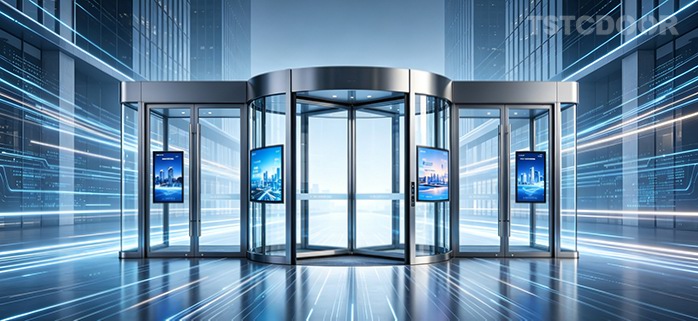
1. Drive System (Motors & Transmission Structures)
Driven by the goals of low energy loss, maintenance-free operation and low noise, the drive system will phase out traditional reduction gear structures and gradually adopt direct drive and contactless magnetic drive, alongside high-performance motors to improve energy efficiency, noise reduction and service life.
▪ Short-term (2026-2028): Brushless DC motors (BLDC) will be widely adopted to replace conventional AC asynchronous motors, cutting energy consumption by over 20% and limiting operating noise within 50dB. Free of brush wear, they achieve a service life of 100,000 hours for general applications such as office buildings, shopping malls and hotels. High-precision harmonic reducers will be matched with brushless servo motors, with transmission accuracy controlled within ±0.1° and noise below 45dB.
▪ Mid-term (2029-2032): Permanent magnet synchronous direct drive motors will become mainstream. Gearboxes will be eliminated, delivering 50% higher torque density, 30% smaller motor size and over 95% transmission efficiency. Featuring high torque at low speed, they eliminate stuttering during start and stop, ideal for hospitals and high-end commercial buildings. Integrated direct drive structures will be popularized to eradicate mechanical wear. Adaptive air pressure balance structures will automatically adjust rotating speed against outdoor wind and indoor-outdoor pressure difference.
▪ Long-term (2033-2036): Hybrid rare-earth permanent magnet reluctance motors will be commercially applied, further reducing energy consumption by 15%. Regenerative braking will recover kinetic energy into electricity, saving more than 200 kWh per unit annually. Magnetic levitation and magnetic coupling drive will be implemented with no physical contact between components. The noise level will drop to ≤35dB and the service life extend to 200,000 hours, realizing near maintenance-free operation for landmark buildings and top-tier commercial complexes.
2. Electronic Control System
The control system will evolve from basic start-stop and speed regulation to an edge intelligent unit with independent decision-making capability. Both hardware and algorithms will be upgraded to connect revolving doors with pedestrian flow and building facilities.
2-1 Hardware Upgrade
▪ Short-term: Traditional PLCs will be replaced by 32-bit ARM embedded controllers equipped with real-time operating systems. The signal response latency will be less than 50ms to support synchronous connection of multiple sensors.
▪ Mid-term: Edge computing controllers integrated with NPU chips will be widely used. Local data processing ensures normal intelligent speed regulation and safety protection even under network disconnection, with adaptive capability for on-site operation scenarios.
▪ Long-term: Heterogeneous computing units combining CPU, GPU and NPU will be adopted to conduct real-time 3D space modeling and pedestrian behavior analysis.
2-2 Control Algorithm Iteration
▪ Short-term: Fuzzy PID adaptive algorithms will be applied. The system dynamically adjusts running speed and passage duration according to pedestrian flow, wind speed and door load, achieving over 15% energy saving.
▪ Mid-term: AI pedestrian flow prediction algorithms will be deployed. Based on historical data, the system predicts passenger peaks and valleys 5 to 15 minutes in advance and switches between high-speed mode and energy-saving standby mode automatically. It can identify wheelchairs, luggage and children to extend safe passage time.
▪ Long-term: Digital twin and reinforcement learning algorithms will be combined to mirror real-time operating status and optimize operation strategies autonomously. The system will be deeply interconnected with Building Automation Systems (BAS) to coordinate elevators, air conditioning and lighting for overall building energy conservation.
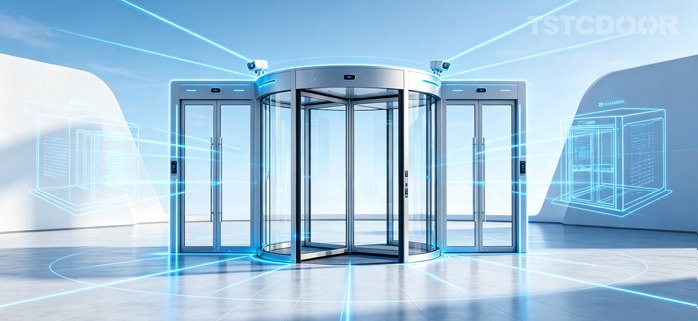
3. Perception & Safety System
Traditional single infrared anti-pinch design will be upgraded to a comprehensive multi-sensor fusion system with all-round protection, realizing active risk prediction, environmental monitoring and abnormal alarm.
▪ Short-term (2026-2028): Millimeter-wave radar and infrared light curtains will form a dual redundant protection system, covering a detection range of 0.1m to 5m. The anti-pinch resistance threshold will be reduced below 50N with a misjudgment rate under 0.1%.
▪ Mid-term (2029-2032): 3D LiDAR and AI vision recognition will be introduced to build a 3D spatial model within a 2-meter radius around the door. The system distinguishes pedestrians, pets and obstacles, predicts movement trajectories and executes deceleration or braking in advance. Distributed pressure sensor arrays will monitor air tightness and adjust sealing components automatically. The door can switch to evacuation mode and unlock within 3 seconds in case of fire emergencies.
▪ Long-term (2033-2036): A multi-modal sensing system integrating LiDAR, vision, ultrasonic and pressure sensors will achieve blind-spot-free monitoring. It identifies violent impact and prolonged loitering, then locks the door and triggers security alarms automatically. Sterilization coatings and positive pressure sealing will be adopted for medical and clean environments to prevent cross air contamination.
4. New Materials & Structural Optimization
▪ Main Frame: Ordinary carbon steel will be gradually replaced by aerospace-grade aluminum alloy and carbon fiber composites. The door weight will decrease by 18% while structural strength increases by 22%, with improved corrosion and aging resistance for harsh working conditions.
▪ Sealing Components: Triple-layer composite EPDM sealing strips with nano-coatings will raise air tightness by 50% against current national standards, cutting air conditioning energy consumption by around 12%.
▪ Door Glass: Low-E insulated laminated glass will be popularized for heat insulation, explosion resistance and sound insulation. Flexible photovoltaic films will be applied on high-end models to generate power from natural light for self-supply of control and sensing systems.
Innovative Structure: Foldable revolving doors will be developed to shrink the entrance during low-traffic periods and reduce cold/hot air loss. Built-in air buffer cavities will further enhance thermal insulation and energy saving performance.
5. Emerging Technologies to Be Implemented
▪ Contactless Access Control: Multi-modal recognition including facial recognition and vein recognition will be integrated for contactless access and identity verification, with a market penetration rate above 80% in public areas by 2032.
▪ IOT(Internet Of Things) Remote Operation & Maintenance: Supported by 5G and NB-IoT modules, real-time data transmission, automatic fault alarm and remote parameter debugging will be realized. Combined with digital twin platforms for full-lifecycle equipment management, the cost of manual inspection and maintenance will be reduced by 40%.
▪ Transparent Interactive Technology: Transparent OLED glass will be adopted on high-end products to display navigation, advertisements and weather information. Voice and touch interaction functions will be available to enhance user experience.
▪ Micro-grid Compatibility: Integrated photovoltaic power generation and energy recovery modules will connect the door to building distributed micro-grids for self-sufficient power supply, complying with standards of zero-carbon buildings and green industrial parks.
6. Overall Development Summary
Over the next decade, technological upgrading of automatic revolving doors will focus on five core directions: energy efficiency, low noise, safety, intelligence and easy maintenance. In the short term, BLDC motors, dual-sensor protection and adaptive electronic control will be promoted to improve existing products. In the mid-term, permanent magnet direct drive, AI perception and edge computing will be fully deployed. In the long run, cutting-edge technologies such as magnetic levitation drive, heterogeneous AI computing and photovoltaic self-power will be applied. Automatic revolving doors will transform from traditional mechanical entrance products into intelligent sensing and energy-saving terminals for green buildings.
 Brief Introduction For Automat
 Certificate of Origin (CO) For
 The Research For Global Hermet
 Are Revolving Doors Worth Inst